
CIEEM at the Labour Party Conference 2026 – by Jason Reeves
Last year was the first time that CIEEM attended a party conference. This year we went back to Liverpool with a bigger presence, as a partner in a full day of nature-focused events as well as a delegate at the main conference. This is my account of the three days at this year’s Labour Party Conference.
Sunday: can nature rebuild Labour’s coalition?
The first event I went to was Can nature help Labour rebuild its coalition?, hosted by More in Common with the National Trust, WWF, the Wildlife Trusts, the Woodland Trust and the RSPB. Luke Tryl presented polling from More in Common’s new Strong Roots report, and the headline numbers were striking:
- 93% of Labour voters say nature is important to them, and over half say it is very important.
- 82% of all voters say nature is important.
- Most voters think politicians don’t care about nature.
- Britons reject the idea that nature has to be traded off against other priorities, and they don’t think environmental regulation is holding back development.
- Planning reforms were among the least popular policies tested, although few people know much about them.
The panel (Toby Perkins MP, the heads of the big nature charities and Nature Minister Jenny Riddell-Carpenter MP) kept coming back to this summer’s drought and wildfires. For many people, climate and nature impacts now feel very real. There was a call for nature to be treated as foundational national infrastructure and valued for its own sake. Craig Bennett wanted to see a move “from encouraging signs to encouraging actions“, with the forthcoming Budget as an early test. The Minister reminded the room that environmental NGOs have more members than all the political parties combined.
A contribution from Luke Tryl made the point that the public likes three things: nature, banning things and apprenticeships. Other members of the panel suggested ways that these could be linked, including restoring peatlands by banning peat sales and creating peatland restoration apprenticeships.
In the evening I went to SERA’s Hope in Every Postcode rally, with a long line-up of ministers, MPs and other elected officials – including the Secretaries of State for both Defra and DESNZ, and by my count at least five junior ministers and another seven MPs in the room – recalling Labour’s successes so far and what more to focus on. It was a celebratory event and included several personal tributes to Hywel Lloyd, who died recently and will be much missed by the Labour environment community.
Monday: regulation, infrastructure and housing
On the Monday I attended a range of events focused on the development agenda. I went to sessions on regulation, major infrastructure and housing.
A few themes recurred:
- The bat tunnel myth is being corrected. Last year I hinted that there was more to the “£100m bat tunnel” story, and this year I heard it from the panels themselves. At Regulating for Growth, Julia Pyke (Clean Power Commissioner, DESNZ) said it wasn’t Natural England’s fault. She put it down to a risk-averse regulator and developer, a consultant fond of over-the-top engineering, and a government that didn’t push back on costs. At the Amey infrastructure session, the Institution of Civil Engineers’ representative made a similar point.
- Certainty. Speakers in the infrastructure and housing sessions asked for certainty on delivery pipelines, planning decisions and skills strategies. One example was New Zealand’s approach of a long 2-year consultation process to get public and local community buy-in followed by cross-party sign-off for big projects. “If we can’t enforce it, don’t do it” was a good line from Polly Mackenzie on effective regulation. Several speakers argued that regulation fails because enforcement and resourcing fail, and were concerned that regulators often have a high proportion of more junior staff because they lose senior expertise to the private sector.
- Climate resilience gets a sympathetic hearing, nature less so. Developers and housebuilders were receptive on climate resilience, which is understandable after this summer. Nature, and Biodiversity Net Gain (BNG) in particular, was still often described as a burden. One SME builders’ session cited regulatory requirements including nutrient neutrality and BNG as a significant driver of costs, though without mentioning the recently introduced 0.2ha exemption for BNG.
- Infrastructure and land use. Several panels noted that homes don’t exist in isolation and need water, energy, transport, schools and GP surgeries planned alongside them, and that housing has to be part of a wider conversation about how we use limited land. Housing Minister Matthew Pennycook said he is lobbied constantly to cut regulations, and that he wants to “pull every lever“.
- Nature and climate belong together. Nature-based solutions came up in one infrastructure session as possibly the most effective climate resilience option as well as the most ethical. We need to move to a position where nature is seen as critical national infrastructure, and green groups have a role in telling a better story about how nature underpins the economy and communities.
Tuesday: Nature Day
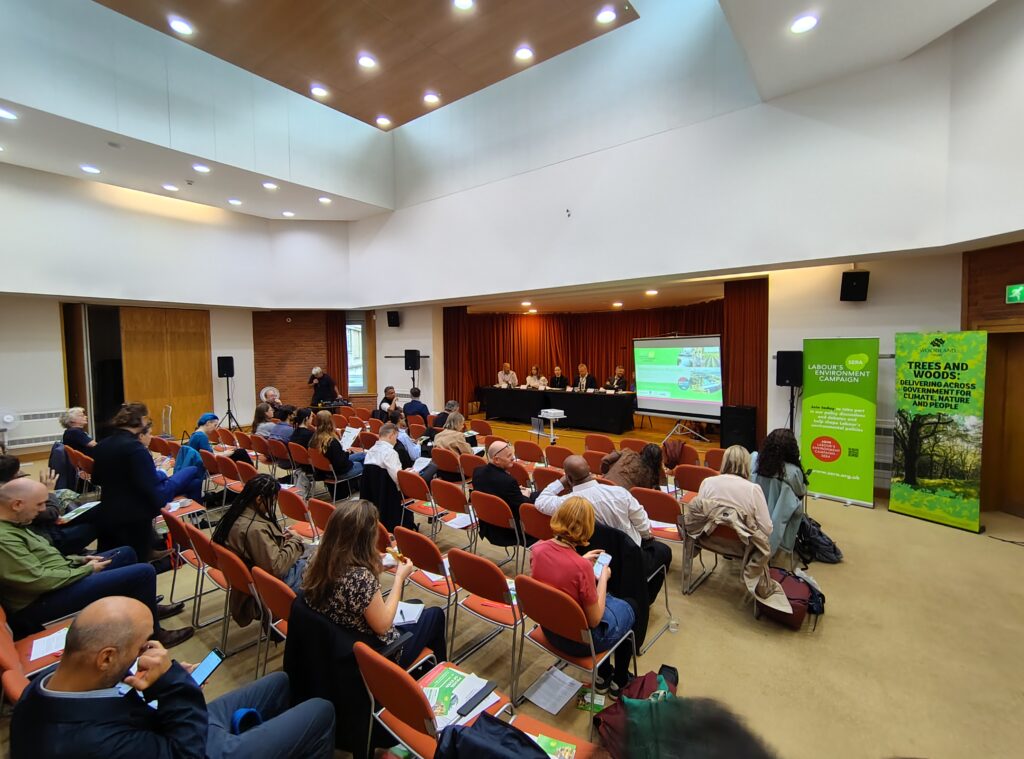 On Tuesday CIEEM was a partner in Nature Day, a full day of four panels at the Quaker Meeting House, organised by SERA with CIEEM, the Woodland Trust, the Wildlife Trusts, the Campaign for National Parks, the National Trust and Mott MacDonald. It was outside the secure zone, so open to anyone to attend. CIEEM Policy Officer Kieran Thomas also attended the Nature Day events and has contributed to the notes for the day.
Panel 1 – Nature in Every Postcode: what does the Makerfield test mean for our environment?
Jenny Riddell-Carpenter MP, Nature Minister, joined representatives of the Campaign for National Parks (Nick Hall), National Trust (Mike Innerdale), Woodland Trust (James Cooper) and Fields in Trust (Helen Griffiths) in a session chaired by Steph Spyro from the Daily Express.
The central message was that we need to get away from nature versus growth, and treat nature as central to place-making. The Minister said she wants to improve access to nature for the most deprived communities, to focus more on 30by30, and to work with partners to do it. She also talked up Environmental Delivery Plans (EDPs) as good for nature and people – although we aren’t convinced and will be publishing more on this in the coming weeks.
Other points from the panel included:
- National Parks need reform of their statutory purpose, including a biodiversity duty and governance changes.
- Panellists called for a green paper on access to nature, pointing out that in many places access is getting worse with inner cities actually losing green space.
- Panellists wanted joined-up design (SuDS, street trees, and nature access linked to public and active transport) and a government that links nature investment to outcomes like health and flood savings.
- With the media focused on defence, data centres, migration and energy bills, there was a question about how to keep nature on the agenda.
- Panellists highlighted that actions to protect nature are very popular with the public, a point that would be raised separately across panels later in the day.
From the audience came a good challenge. The panel had been very urban focused, and the test mustn’t ignore rural communities.
Panel 2 – Planning for People and Nature: how Labour must make nature part of good development
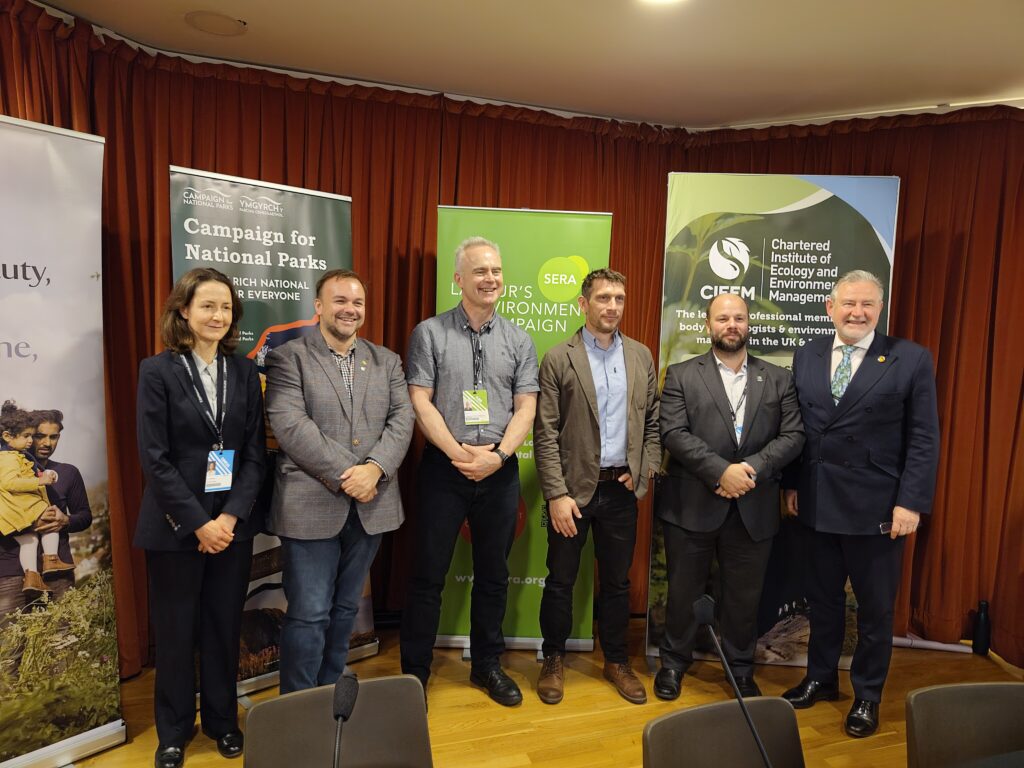 This was CIEEM’s first panel, chaired by Barry Gardiner MP, with Ben Kite CEcol FCIEEM speaking for CIEEM alongside Terry Jermy MP, Julia Baker CEnv MCIEEM (Mott MacDonald), Sam Bower CEnv MCIEEM (Balfour Beatty) and Bill Eyres (SERA).
Ben said reviewing the planning system was the right thing to do, but that the Planning and Infrastructure Act isn’t the answer. EDPs have huge scope between very good and very bad, and he used the Norfolk nutrients EDP, now out for consultation, as an example. It doesn’t directly address nutrients, and a levy or tariff that undercuts existing nutrient credit providers would undermine nature markets. If the interventions don’t tackle nutrient pollution, developers will still face the same problem at the end of the 10-year plan, and be at reputational risk for something that isn’t their fault. This first EDP could set the tone and precedent for others to come. On the EDP consultation, he pointed out that the document runs to 255 pages plus appendices and annexes, with just 28 working days to respond. How are local groups supposed to respond to that? He also mentioned the CIEEM Good Development briefing, which showcases how development and nature can work together.
The other panellists reinforced the case:
Barry agreed the first EDP won’t solve the nutrient problem. He said government is right to support development but must not undermine nature in the process. He lamented the fact that we’re still debating how to protect and restore nature 16 years after the Lawton Review.
Terry, MP for South West Norfolk, said cuts to Local Planning Authorities (LPAs) and Natural England leave no capacity to push back on poor development, and that a healthy environment is the best thing for Norfolk’s economy and its tourism. About a third of his casework is environmental, across all political views.
Sam said nature is an opportunity, not a barrier, and that it needs to be integrated into design from the start. By doing so, we can move beyond simply conserving nature through the planning system, and towards the planning sector becoming a mechanism to improve environmental outcomes (such as water and air quality, and soil health), highlighting the particular opporunity for NSIPs to deliver landscape-scale change to this end EDPs need to be underpinned by evidence and then rigorously monitored and enforced.
Julia flagged that BNG for NSIPs is coming in November, and that the many policy layers (HRA, protected species, protected sites, EDPs) need an overarching joined-up plan built on the Lawton principles. She said we mustn’t forget the mitigation hierarchy, and we need to hold our nerve on improving EDPs.
Audience questions covered concerns over data centres, the possible implications of the Regulating for Growth Bill, a note that nature isn’t political, and a request for more focus on soils.
Panel 3 – Good growth in rural communities
Chaired by Jonathan Davies MP, with James Naish MP (chair of the Labour Rural Research Group), Martin Lines (Nature Friendly Farming Network) and representatives of the Wildlife Trusts (Vicki Hird), Woodland Trust (Abi Bunker) and National Trust (Mike Innerdale).
A key message was the critical importance of soils and water, and that it will be far more expensive to fix issues later if we don’t invest now. Far too little money has been set aside for farmers, with speakers noting that the recent Sustainable Farming Incentive (SFI) rollout is far too small. Martin said the current scheme is more about getting money out the door than delivering for nature, and that we need a baseline of minimum standards for nature on all farms, with procurement shifted towards regenerative farming. Farming also needs to be environmentally and financially viable without relying on SFI to stay afloat.
Panellists also highlighted that any financial support that is available to farmers – through SFI or other agri-environment schemes – must be more long-term and strategic, rather than the short-term changes (sometimes year-to-year) that make environmental planning difficult and provide little certainty to farmers.
James Naish said nature and economic policy need to be seen as linked, and that the Land Use Framework could do this, but that for now it is “just on paper“. He referenced some interested research that the LRRG has published recently on why the rural economy is constrained.
The More in Common research came up again, and so did the poultry sector’s lobbying for a Poultry Growth Plan with the reminder that “cheap chicken is killing rivers“.
Panel 4 – Labour’s Winning Edge: restoring nature, delivering for people
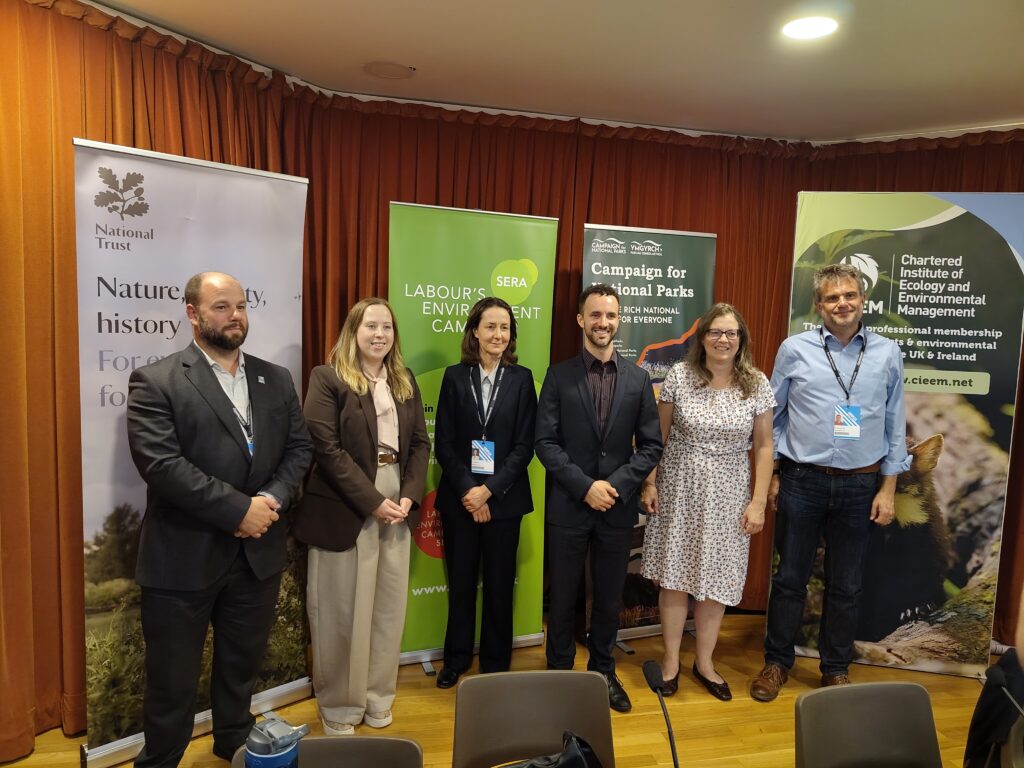 This was the second panel with CIEEM represented by Ben Kite. Lisa Trickett (SERA co-chair) stood in as temporary chair whilst we waited for MPs to get to the venue after the Prime Minister’s speech. The panellists were Becky Gittins MP, Chris Hinchliff MP, Craig Bennett (Wildlife Trusts), Ruth Bradshaw (Campaign for National Parks), Julia Baker (Mott MacDonald) and Ben.
Craig reflected on how much has improved in a year, given that last year the Housing Secretary of State was wearing a Build Baby Build cap. He set out a vision of positive policies on rivers (including wildbelts), nature-friendly farming, housebuilding and cities with nature built in, a nature-positive Great British Grid, and marine protection including a ban on bottom trawling.
Ruth reminded us of Labour’s legacy on National Parks, wants access for everyone, and was pleased planning protections were retained in the revised National Planning Policy Framework (NPPF). She reiterated the points made earlier that National Parks needs reforms to their purpose and governance.
Chris called for a moratorium on damaging any more ancient woodland, and for all farmland to play a role in nature recovery. He also saw a huge job creation opportunity, citing the US Conservation Corps. He added that society has been too snobbish about land-based jobs, which many people want and which are good for physical and mental health.
Ben welcomed the Government’s move away from anti-nature rhetoric, but that we need to rewrite and rethink EDPs. Government also needs to rethink the deregulatory agenda so it doesn’t undermine nature markets, stopping the undermining of BNG to give confidence to habitat banks and investors, amend the purposes of the Green Belt to deliver for nature, and recognise green skills as a great opportunity.
Julia agreed that we need a holistic policy narrative and to keep driving the point that nature underpins the economy. She said the Prime Minister had talked about a lack of trust in politicians, and noted that the same applies to developers, so we should highlight the good work some of them are doing.
Audience questions covered rewetting uplands (linking BNG money with rewilding, and Environment Agency flooding money with Nature-based Solutions (NbS) like beavers and peat ditch blocking), tackling grouse moors, and flood protection for downstream communities. There was a call for green jobs that are secure and open to more than the middle class, and a complaint that government consultation events are held on weekdays when working people can’t attend. Discussion of career opportunities mentioned CIEEM’s Green Jobs for Nature website, and the fact that Natural England staff are paid less than their equivalents in other Defra bodies.
A final rallying message was that we as the nature conservation and ecology sector must not concede any ground on the profile, reputation and parity with other professions that we have worked so hard to build.
The Prime Minister’s speech
As an interlude to the Nature Day events, I watched Andy Burnham’s first conference speech as Prime Minister. There was no mention of nature or climate, and while growth was mentioned, there was less of the rhetoric than we have seen over the past two years. He pushed back against deregulation, and promised more social house building, though it must not be at any cost. The Water Bill he mentioned must include nature restoration and nature-based solutions, and the Great British Grid energy infrastructure he announced is an opportunity for BNG on Nationally Significant Infrastructure Projects (NSIPs). The speech wasn’t the nature moment we would have wanted, but there are some openings.
Overall experience
Last year I wrote that the conference could have done with more input on ecology and nature conservation. This year there was a tangible shift, due in no small part to Nature Day. The bat tunnel myth is being dismantled, nature is increasingly talked about as national infrastructure, and politicians including the Defra Secretary of State and the Nature Minister both said that nature and development can and must work together. More in Common’s polling shows that the public is on the side of nature. The summer’s drought and wildfires have no doubt kept climate resilience as a mainstream concern. The gap I see is still between rhetoric and delivery: EDPs, BNG exemptions, under-resourced LPAs and Natural England, and a deregulatory agenda all still threaten to undermine nature recovery.
It was great to be a partner in Nature Day, and to have CIEEM’s voice, and the Good Development work, heard in the room.
We are already discussing our engagement plans for Labour Conference 2027. Do get in touch if you’d like to be involved.
 Jason Reeves CEnv MCIEEM is CIEEM’s Head of Policy. He has been involved in nature conservation policy and advocacy for over 20 years.