Reaching Net Zero carbon emissions
We are committed to leading the way for our profession in taking urgent action to address the climate emergency and biodiversity crisis.
In September 2019, we declared a climate emergency and biodiversity crisis – but a declaration means nothing without action. That is why we launched Action 2030: a project which will see us reach net zero carbon emissions (scope 1, 2 and 3) by 2030 and lead the way for our professions in taking urgent action to address the climate emergency and biodiversity crisis.
To achieve our mission, we are committed to a number of actions listed in our declaration.
We have since published our Carbon Reduction Plan (CRP) and reviewed our Environmental Policy to get our journey to net zero underway which can be viewed below. The CRP sets out how we will achieve this and our principles for offsetting emissions. We have published ‘Climate Emergency and Biodiversity Crisis: The Facts and Figures‘ which we will review to keep our members up to date on the state of these crises. We have recently explored how pension contributions can help individuals and organisations reduce their carbon footprint.
On this page, you can find more information on our Action 2030 journey and short explanations for some of the terms we’ll be using (e.g. Scopes).
Scope 1, 2 and 3 Emissions
When talking about Greenhouse gas emissions, particularly in the context of business emissions are categorised into three ‘scopes’.
- Scope 1 includes direct emissions from sources directly owned or controlled by the organisation. As CIEEM no longer produces direct emissions e.g. gas fuel, this is of low relevance.
- Scope 2 includes indirect emissions, for example from the generation of emissions from purchased utilities. This relates to CIEEM’s electricity usage and where we get our electricity from.
- Scope 3 covers all other indirect emissions from the organisation’s activities and supply chain. This is CIEEM’s largest contributor to emissions, as it includes all our other operations and activities.
Progress so far
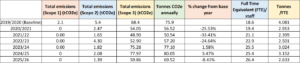
The above table shows CIEEM’s total CO2 emissions each year since our baseline (2019/2020), as well as how this compares to the number of full time equivalent staff (FTE). As can be seen in the table, our emissions are primarily generated under the Scope 3 bracket. Our top contributors to this number currently are:
- Staff Commuting
- Venue usage/hire
- InPractice
We’re proud of our progress in achieving Action 2030 so far and have already made some great steps in reducing our carbon emissions. However, we know we have some hard choices ahead, which we and our Action 2030 Working Group are hard at work tackling right now.
Influencing Policy
The climate emergency and biodiversity crisis is a key focus topic for the Strategic Policy Panel. They will continue to highlight these crises where possible and call for action using nature-based solutions. The work of our Country Policy Groups and Policy Team will also feed into this, looking at how changes can be implemented across the UK and Ireland.

Action 2030 Working Group
One of the key commitments of our declaration was to set up a member-led working group to devise ways in which we, as a profession, can address the climate emergency and biodiversity crisis. The Action 2030 working group is a sub-committee of the CIEEM Governing Board.
The Action 2030 working group will:
-
- Challenge and provide advice to CIEEM on achieving net zero carbon emissions by 2030 in all of its operations and activities.
- Identify means by which CIEEM can lead change to professional practice to reflect opportunities to address the climate emergency and biodiversity crisis.
- Provide information and advice to members on how they can help to address the climate emergency and biodiversity crisis through their professional work.
- Promote the use of nature-based solutions to address the climate emergency.
-
- Build relationships and share knowledge with other relevant climate emergency and biodiversity crisis working groups.
More information can be found in the Action 2030 Terms of Reference (March 2023).
MEET the Action 2030 Working Group
Resources from the Action 2030 Working Group
CIEEM’s Carbon Compensation
Each year, CIEEM donates a sum of money to a particular project that delivers tangible benefits for climate and nature. This is our way of compensating for those emissions that we have not managed to prevent. Our Action 2030 Working Group is an integral part of finding and choosing these projects, using CIEEMs Compensation decision matrix to determine which projects CIEEM’s money should go to.
Principles agreed by CIEEM to guide the choice of compensation schemes for carbon emissions
- Additional – it is fundamental that offsetting funds do not pay for work that would have happened anyway.
- Verifiable – verification and certification of the CO2 offsetting in a transparent and accountable process.
- Remove CO2 from the atmosphere – nature-based solutions that create new habitats and restore existing habitats and ecosystems will help to address the biodiversity crisis and deliver ecosystem services.
- Permanent – the CO2 removed from the atmosphere should not be released in the future except through natural processes and habitat management.
- Undertaken in real-time – CO2 emissions should be offset simultaneously with their generation or over a defined short period of time.
- Based locally – offsetting schemes should ideally be based in Britain or the island of Ireland.
- Avoid negative impacts – offsetting schemes should have a very low risk of creating unintended consequences for people or the environment.
To take a look at all the different projects we’ve donated to you can explore this map!
What can you do?
If you’re interested in starting your own carbon emission or Action 2030 Journey, you can take a look at our “How you can address the Climate Emergency and Biodiversity Crisis” Page!