
Obituary: Dr Jonathan Mitchley MCIEEM (Dr M)
By Dr Mark Nason MCIEEM, Head of Professional Practice, CIEEM
Last week we lost one of the UK’s foremost botanical evangelists and champion of ecological skills with the passing of Dr Jonathan Mitchley, aka Dr M. A member of CIEEM for the past 30 years, Jonathan will be deeply missed by the Institute, the wider ecology and environmental management community, and the many colleagues, students and former students whose lives and careers he influenced. Jonathan helped shape generations of ecologists and botanists across the world, his influence will endure far beyond his passing and CIEEM honours his immense contribution to our profession.
Jonathan was Associate Professor of Field Botany at the University of Reading. He built a career that moved comfortably between teaching, research, and consultancy, and in the process he trained a great many of the ecologists now working across our sector. He grew up in Canterbury before reading botany at Bangor University at a time when the department was led by the eminent plant ecologist Professor John Harper, who had a big influence on his chosen career path. He went on to a PhD in grassland ecology at Cambridge with Professor Peter J. Grubb where his lifelong fascination with grasses took hold, then to further research posts at Lancaster and Utrecht Universities. It was in Lancaster that the young Jonathan joined John Rodwell’s group developing the National Vegetation Classification, a highly formative experience of which he was incredibly proud, going on to write a book on coastal habitat management before taking up another postdoctoral position at Utrecht University. A senior lectureship at Wye College followed, where among other things he worked on revegetating chalk spoil produced by the digging of the Channel Tunnel, creating the man-made nature reserve at Samphire Hoe. He ran an EU-funded BioScene project (how farming changes affect biodiversity across six mountain study areas in Europe) working alongside preeminent restoration ecologists in Europe such as long-standing colleague and friend Dr Ivana Jongepierova and Dr Karel Prach and was a Board Member and ran the social media for the European Chapter of the Society for Ecological Restoration. He also became a valued contributor to CIEEM’s Ecological Restoration Special Interest Group.
After Wye, in 2007, he was appointed to a new jointly funded post, split between University of Reading and Carter Ecological. This shared post developed Jonathan as both an academic and a botanical consultant bridging theory and business. Indeed, during his ten years as a Senior Botanical Consultant at RSK Group Ltd, he began to develop his mission to raise the importance of botanical field skills in the pipeline between university and industry. In typical Jonathan style, he appeared once as James Bond at a company meeting to present his plans for a Botany Licence (Licence to Botanise) to highlight that botanical skills mattered as much as training for a bat or great crested newt licence.
In recent years, Jonathan was programme director of Reading’s ecological survey skills master’s degree with placement, a course that achieved a 100 % employment rate for its graduates in related careers, and which CIEEM was proud to recognise with our Higher Education Programme of the Year Award in 2024. Year after year he sent out into the sector ecologists who could not just talk about plant identification but do it confidently and well, and he went above and beyond to ensure that all of his students secured suitable placements. He helped students of all ages ‘see’ plants, triggering a fascination of plants and equipping them with the tools and wonder to continue on their own. He particularly enjoyed watching the penny drop amongst the most sceptical of students, many of whom came in with little or no botanical training.
Anyone who has struggled to find a suitably skilled botanical surveyor will understand what a quietly vital contribution that was and how much of the current strength in UK field botany, among younger ecologists in particular, can be traced back to Jonathan’s teaching.
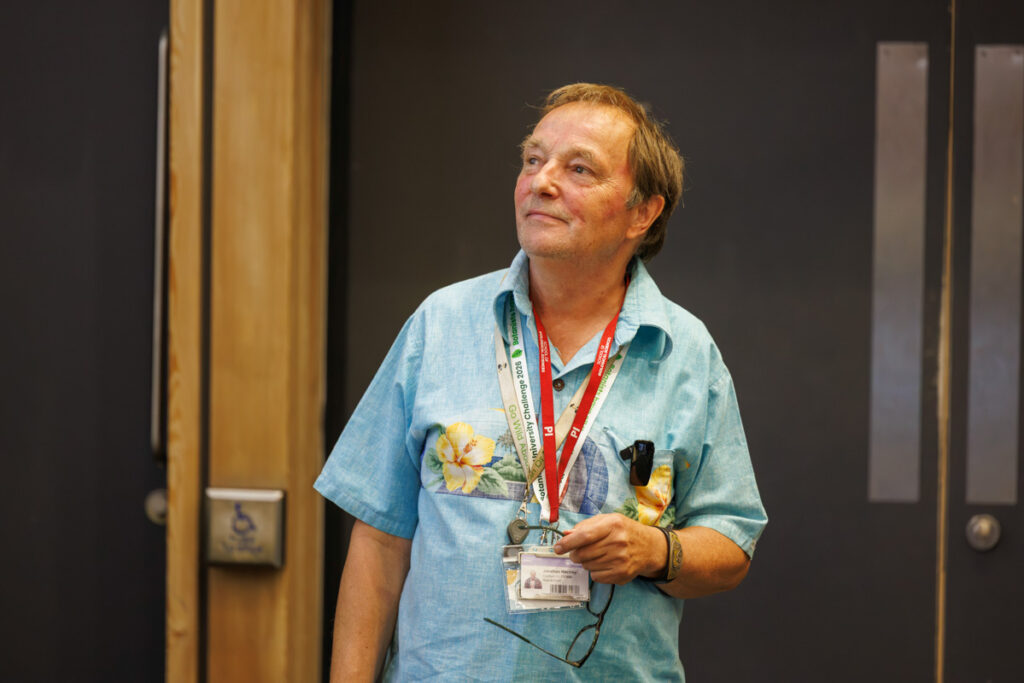
Anyone who met Jonathan will know that all this was delivered with a very particular style. He taught in outlandish outfits, sang in the middle of lectures, and was rarely seen without his hand lens on a lanyard around his neck, used by his own admission, as often for reading text messages on his stubbornly low-tech phone as for identifying rare grasses. After achieving FISC Level 6, he wore an ‘I am 6’ badge for some time afterwards. It was a typical Jonathan gesture. He was determined to put himself through the test despite the reputational risk if he had scored any lower, which many good botanists are scared to do, while reminding everyone that the real point was to open eyes to the wonder of plants and enjoy the process. He rebranded himself online as ‘Dr M Goes Wild’, turning what could have been dry technical content into something unique, funny and shareable, and in doing so did more for public engagement with botany than most of us manage in a career of more conventional outreach. He knocked the stuffiness out of botany and rejuvenated the subject. He was also a proper musician: a fixture of the University of Reading choir, and the organiser this year of a sold-out concert series, Music at Acacias, which included one evening given over to the vocal talents of a concert tenor by the name of Jonathan Mitchley. True to form, he also found a way to combine two of his favourite things when he helped brew a bespoke beer, Whiteknights Cedar Ale, to mark the 50th anniversary of Reading’s botany master’s degrees in 2019. The beer was launched alongside The Big Botany Challenge, a symposium and pipeline project exploring gaps in whole-plant education at secondary school level, and why many students were entering university and industry without firm foundations in the subject.
That conviction, that botanical skills matter and that they should be enjoyable to learn, drove him to found Botanical University Challenge (BUC) in 2016, together with Dr John Warren of Aberystwyth University and Dr Paul Ashton of Edge Hill. What began as a single, gloriously chaotic event at Kew Gardens grew, under Jonathan’s increasingly careful stewardship, into an annual national competition and full Student Festival of Botany, now in its ninth year and drawing students from across the UK and Ireland. This August he was, by all accounts, exceptionally proud to oversee the latest BUC at Whiteknights, held as part of the University of Reading’s Centenary celebrations, with a record 32 universities taking part. Dr John Warren, who co-founded BUC with him and remained a close friend for over two decades, told me that whilst Jonathan had been unwell in the weeks beforehand, his health visibly rallied once he was back among students at the event, and he seemed, in John’s words, to feed off the positivity that BUC generates.
Whatever else Jonathan achieved, and there was a great deal, BUC’s real legacy is the number of students it has helped feel part of a botanical community, many of whom have gone on to build careers in ecology and environmental management they might otherwise never have considered. Ask Jonathan himself though, and he might have argued the point. He was fond of insisting, entirely straight-faced, that the true crowning achievement of his entire career, was Botanical Rhapsody with his singing group The Dairy Project, his glorious musical tribute to plant science, and a distillation of the belief that sat behind everything he did – that botany should above all else, be fun.
That is what I think many people will remember Jonathan for, his botanical expertise, and his insistence that once you see the wonder of plants, field skills, taught well, can be championed and fun to learn. A remarkable number of good ecologists now working across our sector owe their start in one way or another, to him.
On behalf of CIEEM, my thanks and my condolences go to his family, friends and colleagues at Reading. In his memory, the team that have supported the organisation of BUC commit to continuing the endeavour.
With thanks to Susan Medcalf and Dr John Warren for sharing their memories and reflections on Jonathan’s life and contribution to botany, and to Laura Bennetto for sharing her photo taken at this year’s BUC. For anyone wishing to share their memories of Jonathan, you can write to [email protected] an address curated by close friends and colleagues.