
New IFoA Report Warns of Nature Loss as a Major Financial Risk
 A significant new report – from outside the environmental sector – is adding to the growing number of voices calling for nature loss to be treated as a systemic economic and societal risk.
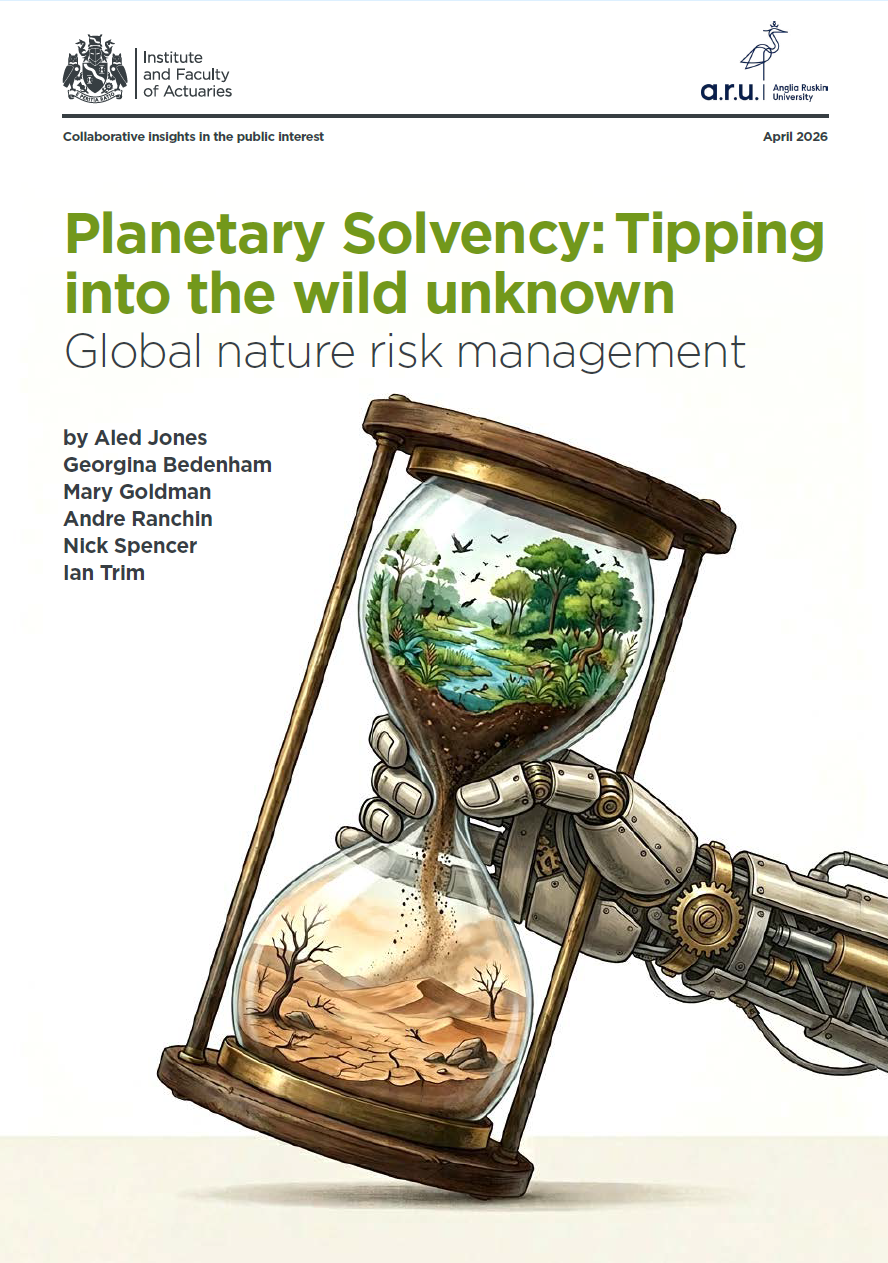
Planetary Solvency: Tipping into the Wild Unknown – Global Nature Risk Management, published by the Institute and Faculty of Actuaries (IFoA) and co-authored by Georgina Bedenham, Head of Climate and Disaster Risk at the Government Actuary’s Department (GAD), argues that nature is critical infrastructure underpinning food systems, water supply, human health, climate regulation and economic activity, and that its loss poses urgent financial risks that can no longer be ignored.
The report is the latest in the IFoA’s Planetary Solvency series and calls on actuaries, policy-makers and financial institutions to integrate nature risk into their models and decision-making frameworks. It highlights near-term risks already emerging, including soil degradation, water stress and pollinator decline, as well as acute shocks such as breadbasket failures and trade disruption. It also flags the link between deforestation, land-use change and zoonotic disease spillover (a risk made very clear by the COVID-19 pandemic) and warns that ecosystem tipping points such as coral reef or pollinator collapse could cause irreversible harm in the very near future.
Crucially, the report concludes that climate-only modelling is no longer fit for purpose, given the deep interdependencies between climate change and biodiversity loss. It calls for biodiversity metrics and qualitative, narrative approaches to risk management to be adopted alongside traditional quantitative methods.
For the environmental sector, this publication is yet another valuable addition to the evidence base. It represents another example of a government-linked body – operating entirely outside the environmental sector – reaching the conclusion that nature loss is a critical issue demanding urgent action. The financial and actuarial communities are increasingly speaking the language of ecological risk, and reports such as this can be powerful tools when making the case to policy-makers and decision-makers who may be more receptive to economic framings.