

Landmark national security report on biodiversity loss released with little public attention
A major new UK Government national security assessment warning that global biodiversity loss and ecosystem collapse pose a direct threat to the UK’s national security has been quietly published, and with little public or political attention.
Released yesterday with no press briefing, headlines or apparent ministerial comment, the report has landed amid a news cycle dominated by the World Economic Forum in Davos. Yet its conclusions are stark and far-reaching, with profound implications for environmental policy, planning and public investment in nature.
The assessment explicitly recognises nature as a foundation of national security, stating:
“Nature is a foundation of national security. Biodiversity loss is putting at risk the ecosystem services on which human societies depend, including water, food, clean air and critical resources.”
It warns that the impacts of biodiversity loss range from crop failures, intensified natural disasters and infectious disease outbreaks to political instability, conflict and erosion of global economic prosperity. As natural resources become increasingly scarce, the report concludes that competition between states and non-state actors will intensify, exacerbating existing conflicts and creating new security risks.
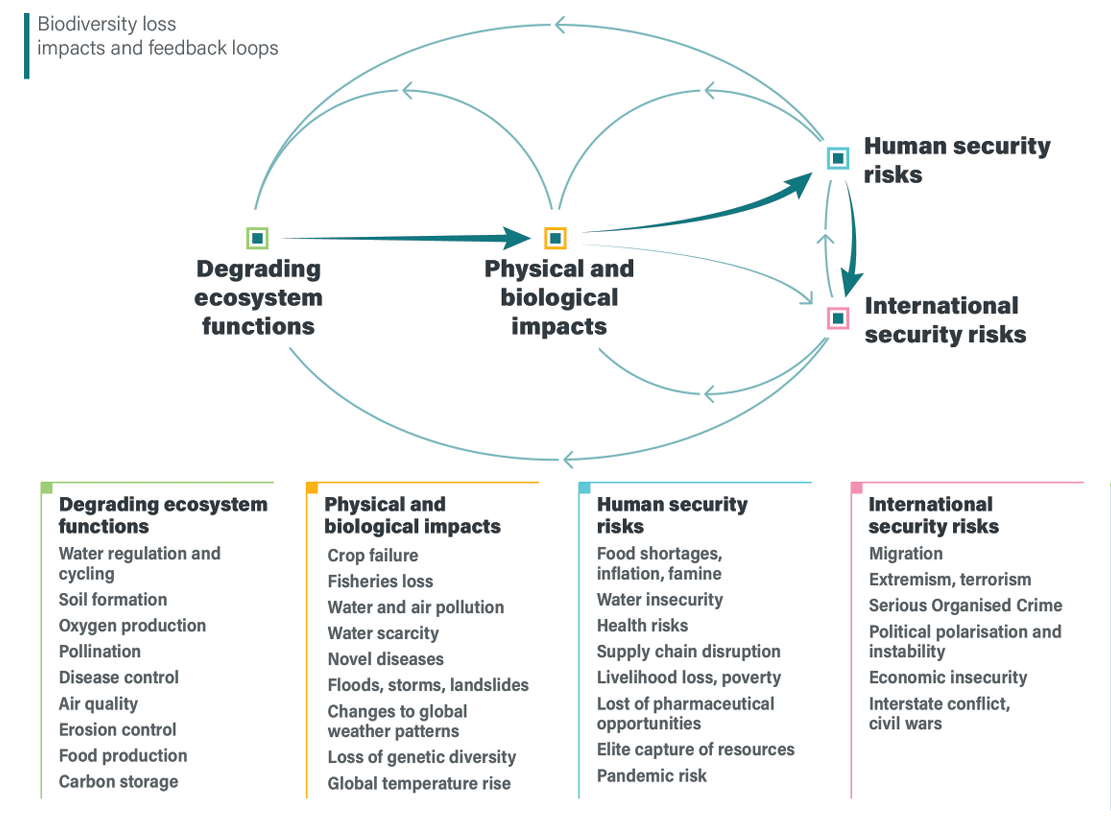
Of particular concern is the report’s conclusion that, if current trends continue, every critical ecosystem is on a pathway to collapse, and that ecosystem collapse is highly likely to drive national security risk. The assessment highlights that ecosystem degradation or collapse will directly challenge the UK’s food security, noting the UK’s reliance on global markets for food, fertiliser and animal feed, and its limited capacity to absorb shocks to global supply chains.
These findings sit uneasily alongside recent policy decisions. The report’s emphasis on ecosystem protection, restoration and long-term resilience contrasts sharply with the approach taken in the recently passed Planning and Infrastructure Act, which adopts a high-risk approach to nature conservation rather than properly funding and resourcing schemes and approaches that have been years in development.
The assessment also raises serious questions about capacity and resourcing. At the same time as biodiversity is formally recognised as a national security issue, Natural England, the statutory body tasked with the protection and recovery of England’s natural environment, has seen its operational budget reduced year on year for the past two decades. This sustained erosion of capacity undermines the UK’s ability to respond meaningfully to the risks identified in the report.
There is also a growing concern that this assessment may follow the same trajectory as the Dasgupta Review on the Economics of Biodiversity. Commissioned by HM Treasury and published in 2021, the Dasgupta Review demonstrated clearly that the UK economy, and global economic prosperity, is fundamentally dependent on the natural environment. It called for a wholesale shift in how nature is valued, embedded and invested in across economic decision-making.
This new national security assessment reaches a strikingly similar conclusion, once again setting out the UK’s deep and unavoidable dependence on the natural environment, this time through the lens of food security, geopolitical stability and conflict risk. Yet despite having commissioned the Dasgupta Review, government now rarely references it at all, and its recommendations appear to have been quietly sidelined.
The muted release of this latest report raises the question of whether another authoritative, evidence-based warning about the central importance of nature will be acknowledged, or simply ignored.
Green Alliance is also reporting that there is a fuller internal version of the document that Government is refusing to publish.
For CIEEM’s members working across ecological and environmental disciplines, the message is unambiguous: Biodiversity loss is no longer solely an environmental issue. It is a matter of national security, economic stability and societal resilience. Professional ecologists are key to a future for society that is safe and secure.
CIEEM will continue to press for policies that reflect the scale of risk identified in this assessment, and for sustained investment in the people, institutions and ecological systems that underpin the UK’s long-term security and prosperity.