
International Focus – Using machine learning to analyse camera trap footage
...in the region. Given the sensitivity of the species in question, a robust baseline is essential. Our aim was to gather enough data to understand the species’ population size and...
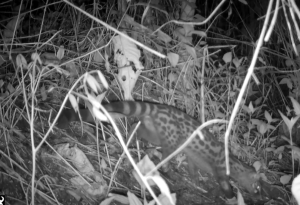
Camera trapping is a widely used tool in gathering baseline data for ecological assessments. It is relatively non-intrusive and can be used to gather large amounts of data in remote areas at all times of day in all weather. However, processing that data can be a time-consuming task that relies heavily on humans conducting repetitive tasks that test our attention spans.
Increasingly, we are seeing software that can help with these tasks. At SLR, Matthew Whittle and Dixy Msapato, Data Scientists in our Geospatial & Data Solutions team have used a publicly available model to develop an internal tool that supports our camera trap footage analysis. This has enabled us to take a more cost-effective approach to the data analysis for projects, including a recent project involving a primate baseline survey in Africa.
 Previous field and desk-based research had shown the potential presence of threatened species of primates, including chimpanzees, in the region. Given the sensitivity of the species in question, a robust baseline is essential. Our aim was to gather enough data to understand the species’ population size and distribution. These baseline data will be used to assess potential impacts on primates and develop appropriate mitigation for the project.
To achieve this, we deployed 60 camera traps over an area of around 260 km2 for over six months. Despite some significant rain damage, and the occasional stolen SD card, this resulted in a total of 8,924 videos. To improve the efficiency and accuracy of analysing these videos, the first step was to run them through our internal tool.
Our tool is a computer vision model system that uses SpeciesNet wildlife detection and classification models, which is a model that has been trained on camera trap imagery of wildlife across the globe. Our data science team has incorporated this model into a system capable of processing 100s of gigabytes of video footage, frame by frame, in just a few hours. The output is a classification of the species into one of the pre-set categories.
The training data available for the area we were working in was quite limited due to being less well studied. Therefore, getting identification to species level was generally not possible. Typically, it was possible to get the recognition to order or family level and the tool was effective at recognising primates. This meant we were able to reduce the videos needing further analysis from 8,924 to 1,600, a much more manageable task.
Those videos were sent to our experienced in-country partner who was able to identify the species, and provide data on the group size, age, sex, and behaviour. These findings will also be used to train our tool to make it more accurate on future projects.
 Ultimately, our in-house tool improved the accuracy and efficiency of the baseline data collection process. We are seeing machine learning being increasingly used across the ecology sector, such as in acoustic monitoring, or SLR’s automated habitat mapping software. There will, though, always be a need for expert input into data collection and analysis.
These tools and software are continually improving and will be increasingly used in ecology and conservation. They have incredible potential, but they still have their limitations. These tools need data, which can be hard to come by, and they require expert guidance. Ultimately, especially with chimpanzees, there is no substitute for expertise gained from studying these animals in the field.
Finally, our cameras didn’t just observe primates. We saw pangolins, birds, event bats, and so much more. We’ve barely scratched the surface of how useful these data can be in conserving this wide variety of species.
 Fraser Wilkinson ACIEEM
Associate Consultant, International Biodiversity – SLR Consulting