
Government report on Habitats Regulations reveals only 3% of England’s habitats in favourable condition
The Government has published a new report assessing the implementation of the Habitats Regulations in England between 2019 and 2024, providing the first England-level evaluation of conservation measures for habitats and species protected under the Habitats Directive and Wild Birds Directive.
Published yesterday (22 January 2026), the Habitats Regulations 9A Report for England (2019–2024) assesses measures taken to support the conservation status of protected habitat types and species, including wild birds, as required every six years under Regulation 9A of the Conservation of Habitats and Species Regulations 2017 (as amended).
The report evaluates conservation measures, their impacts, pressures on habitats and species, and monitoring carried out during the reporting period. The data underpinning the assessments will be published by the end of February 2026 on Natural England’s Access to Evidence platform.
Key findings
The report assesses the conservation status of:
- 71 habitat types and 74 non-bird species occurring in England and listed in the Annexes of the Habitats Directive; and
- 221 bird species relevant to England under the Wild Birds Directive.
The findings paint a stark picture of the state of nature in England:
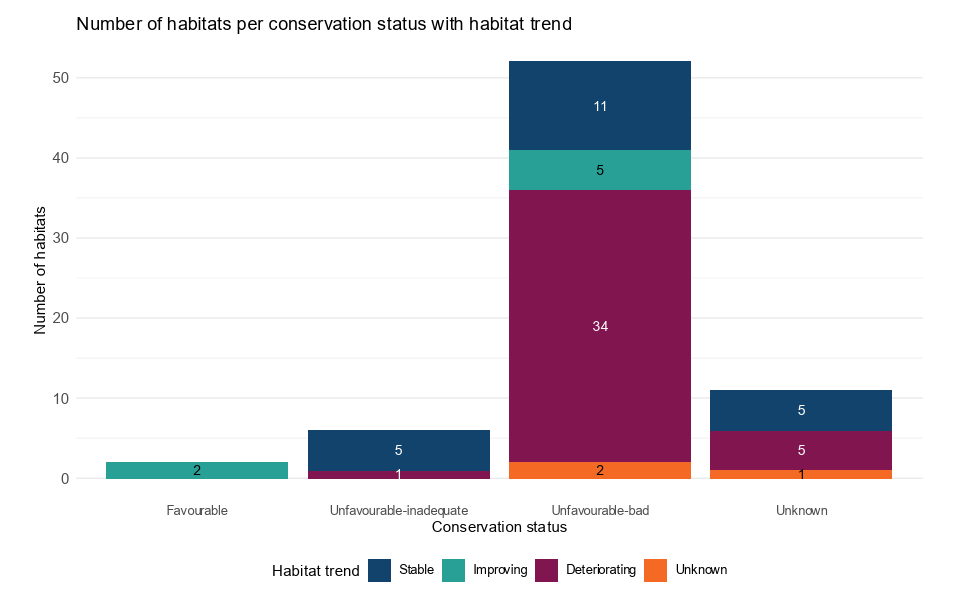
- Only 3% of habitat types were found to be in favourable conservation status (FCS), defined as a situation where a habitat or species is thriving across its natural range and expected to continue to do so.
- 48% of habitats are in an unfavourable and deteriorating condition.
- Among non-bird species, 30% were assessed as being in favourable conservation status.
Direct assessments of favourable conservation status were not undertaken for birds. However, of the 221 bird species included, 117 (53%) are either Red-listed under Birds of Conservation Concern or classed as threatened with extinction on the GB IUCN Red List, indicating that at least half of England’s bird species are not in favourable condition.
Long-term population trends show 44% of bird populations declining, with 48% stable or increasing. Short-term trends are more mixed, with 30% declining and 51% stable or increasing, while the remainder have unknown trends.
Pressures and responses
Agriculture-related activities, including intensive grazing and water pollution, were identified as the main pressures on habitats and non-bird species, and the second most significant pressure affecting bird populations.
Climate change was identified as the biggest current and future pressure for birds, the second biggest pressure for non-bird species, and the most frequently cited pressure affecting 100% of marine and coastal habitats.
Disease has emerged as an increasing pressure on bird populations, particularly due to outbreaks of Highly Pathogenic Avian Influenza and Trichomonosis.
The most commonly reported conservation measures relate to addressing agricultural pressures, largely delivered through agri-environment schemes.
For birds, development pressure was most frequently identified, with mitigation relying on the application of the National Planning Policy Framework, Environmental Impact Assessment, and Habitats Regulations Assessment processes.
Wider context
Alongside the England report, the Joint Nature Conservation Committee (JNCC) has published the UK Offshore Implementation Report, as required under offshore habitats legislation.
A UK Composite Report, incorporating an evaluation of overall progress and the contribution of the national site network, is due to be published by 2028.
These catastrophic numbers must be a wake up call for every politician in England, especially in light of the recent report on national security and biodiversity.
Water pollution from intensive agricultural pollution is singled out as a key culprit, yet the Water White Paper had no tangible measures to clean up farming.
Climate change is another significant, including to 100% of marine ecosystems, yet here we are with international reports confirming that 2025 was the third hottest year on record and that global temperatures have now exceeded 1.5 degrees Celsius warming (relative to pre-industrial times) over the last three years. Yet despite this we have major political parties threatening to repeal the Climate Change Act.
Government must act now, or wildlife will be lost forever.
CIEEM will continue to scrutinise the implications of this report and continue to play our role in improving the implementation of the Habitats Regulations, including through advice to Natural England as it updates guidance.