

Book review – Rare Plants
 Rare Plants – by Peter Marren (Bloomsbury Wildlife 2024, British Wildlife Collection volume 14)
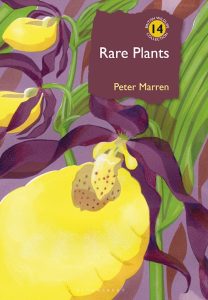 Rare Plants – by Peter Marren (Bloomsbury Wildlife 2024, British Wildlife Collection volume 14)
Marren’s writing will be familiar to readers of British Wildlife (he was the ‘Twitcher in the Swamp’) and this lavishly illustrated book is in his standard easy to read but informative style. This is more than an update of his previous book on this topic, Britain’s Rare Flowers, published in 1999, giving meticulously researched accounts of individual species along with insight into the work of a serious botanist seeking out rarities and those looking after them. It is a weighty tome but don’t be put off by this. Rather than being arranged by taxonomic group it deals with the wider philosophical issues plaguing plant conservation with thought ideas on how we can move forward.
The first chapter introduces the concept of rarity, suggesting that while we all know what this means in theory a deeper delve into different types is needed. Those familiar with the earlier book may remember Marren’s adaptation of Malvolio’s letter in Shakespeare’s Twelfth Night: “some are born rare, some achieve rarity and others have rarity thrust upon them”.
Chapters 3 and 4 deal with new arrivals, natives, archaeophytes and neophytes, reminding us that the plant palette is dynamic and we now have at least as many neophytes as native plants and that this group is now considered to be smaller than previously thought (page 101-2).
Endemics are covered in Chapter 5, micro-rarities in Chapter 6 and Hybrids in Chapter 7 (was the ‘missing link orchid’, a cross between the man and monkey orchids, a natural hybrid or the result of pollination by a mischievous botanist?).
Chapter 8 gives an account of those flowering plants that are thought to have been lost. The ghost orchid, which reappeared shortly after being declared extinct in 2009, is mentioned here along with the heartening fact that 430 once thought extinct plants have been rediscovered alive and well (page 210).
Chapter 9 delves into the world of non-vascular plants with the remainder of the book, chapters 10-13 returning to the thorny issues of what can loosely be described as the challenges of plant conservation and what can be done in response. As Marren states (page 364) the setting of targets has a long history of failure, other than the first Aichi one, which was to raise awareness of biodiversity. The challenging question of whether it is possible to conserve the Earth’s full quotient of species is discussed and he suggests that, while we act as if we believe this is possible while we know in fact that it is impossible. Is rewilding a solution? Many rare plants have narrow, specialized niches, so can be out competed and Marren poses the question as to which is wilder, a re-introduced native or a non-native growing where it pleases (page 373).
This is a thought-provoking and well researched book. It challenges the reader to think deeply about what ‘we’ are doing and ending with the positive message that, despite the shortcomings of protective measures, no flowering plant has been lost in the last 45 years (page 378), largely attributed to the army of volunteers who work on nature reserves and other places managing vegetation and monitoring rare plants and other wildlife.