

Advancing Standards in the Use of Conservation Detection Dogs: Applications, Methods, and Pathways to Success
Written in anticipation of CIEEM’s 2026 Scotland Conference, Fieldwork Futures: Innovations in Ecological Practice, where Louise Wilson of Conservation K9 Consultancy will be presenting.
Having worked with specialist detection dogs for more than two decades, I have watched the use of dogs within conservation develop enormously. What was once a relatively little-known approach is now becoming an increasingly recognised tool for ecological survey, research and conservation.
My own background with detection dogs began long before conservation became my main focus. Over the past 24 years, I have worked as a specialist detection dog handler, trainer and instructor across disciplines including explosives, drugs, cash, tobacco and human remains, before moving into wildlife crime and conservation detection work in 2008. That breadth of experience has shaped how I approach conservation detection today – particularly my belief that successful deployment is about far more than teaching a dog to find an odour.
An exciting new era
Conservation detection dogs are now being used across an extraordinary range of applications: locating protected species and their field signs, detecting invasive species, supporting biosecurity, finding carcasses and scats, and even searching for rare and endangered plants.
Their ability to detect odour beyond what we can perceive through traditional observation opens up possibilities for ecological surveying that we are only beginning to explore.

Specialist conservation detection work can take dog-handler teams into challenging field environments.
My own conservation work has taken me across a diverse range of targets including water vole, otter, pine marten, hedgehog, mink, bats, birds, rodents, invasive species, wildlife crime and endangered plants.
From research to real-world conservation
I have also been fortunate to contribute to some innovative UK projects that demonstrate what can be achieved when detection dog expertise and ecological knowledge come together.
These include working alongside Nikki Glover and Wessex Water on the Great Crested Newt detection dog project, contributing to research, development and subsequent guidance.
I have also been involved in the exciting Saving Scotland’s Red Squirrels specialist detection dog project, training handler Libby Welbourn for this pioneering application using a specialist detection dog to locate grey squirrel dreys. The project demonstrates how carefully developed detection dog methods can support practical, targeted conservation and contribute to the protection of Scotland’s native red squirrel populations.

Henry demonstrating another valuable wildlife detection tool working alongside traditional survey methods, including camera trapping.
More recently, we completed a successful collaborative project with the Environment Agency and Rex, our specialist otter holt detection dog and the first dog trained specifically for otter holt detection. The project delivered fantastic outcomes, demonstrating the potential for specialist detection dogs to locate otter holts and resting sites that can be extremely challenging to identify through conventional survey alone. It provided valuable ecological information while breaking new ground for the application of detection dogs within UK conservation.

Rex, our specialist otter holt detection dog, working in the field.
Different species. Different environments. Different applications – but all showing what can be achieved when specialist detection dog expertise, ecological knowledge, research and collaboration come together.
From finding odour to operational competency
As applications become more ambitious and demand for conservation detection dogs increases, our methods and professional standards need to develop alongside them.
Teaching a dog to recognise and indicate a target odour is only the beginning. Developing a competent operational conservation detection dog team requires appropriate, progressive training and assessment that reflects the realities of real-life deployment.
Conservation fieldwork can involve challenging environments, difficult terrain and potentially hazardous situations. Both dog and handler need to be properly prepared and assessed for the work they are undertaking, with welfare, safety and reliable performance at the forefront.
There also needs to be professional accountability. Teams should be able to demonstrate that they are appropriately trained, assessed and competent for the specific work they are being commissioned to undertake.
Ultimately, competency is not simply about whether a dog can find a target – it is about whether the dog-handler team can operate safely, professionally and reliably in the real world.

Real-world deployment requires training, assessment, welfare and safety to be built into the whole dog-handler team.
Good practice and shared standards
The recently published Wildlife Detection Dogs for Ecological Surveys and Conservation Research: UK Good Practice Guidelines, which I have been involved in developing alongside colleagues, are an important and positive step towards greater consistency and shared expectations as this field continues to grow.
Choosing the right team
As more organisations embrace conservation detection dogs, end users also need to understand what they are commissioning.
As with any specialist ecological service, appropriate due diligence matters. Understanding a team’s training pathway, length of training, target-specific experience, independent competency assessment, methodology, welfare and biosecurity helps ensure the right team is matched to the right project.
Conservation resources are precious. We need confidence that investment in detection dog services supports competent teams capable of producing meaningful, reliable ecological data and, ultimately, positive conservation outcomes.
Where do we go next?
Conservation detection dogs are not here to replace ecologists or established survey methods. They are another specialist tool within the ecological toolbox – one which, when appropriately trained, assessed and deployed, can help us gather information that may otherwise be incredibly difficult to obtain.
At the CIEEM Scotland Conference 2026, I will be exploring this further in my presentation, “Advancing Standards in the Use of Conservation Detection Dogs: Applications, Methods, and Pathways to Success.”
I’ll be sharing experiences from operational projects and looking at the applications, methods, training, welfare, assessment and collaboration that sit behind successful deployment.
The future of conservation detection dogs is incredibly exciting. But our success should not be measured by how many dogs enter the field – it should be measured by the standards we set, the competency we demonstrate and, ultimately, the conservation outcomes we achieve.
So perhaps the question we should all be asking is:
“Can we demonstrate that this dog-handler team can deliver reliably, ethically and to a standard that gives us confidence in the ecological data they produce?”
Photo credits
Photographs supplied by Conservation K9 Consultancy. Please replace or expand this credit with individual photographer names before publication where required.
About the Author
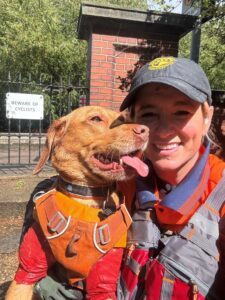 Louise Wilson is Director of Conservation K9 Consultancy and one of Europe’s most experienced conservation detection dog specialists. With over 20 years’ experience in dog handling, training, and operational deployment, she has worked internationally across conservation, wildlife crime, biosecurity, and ecological survey projects. Louise has pioneered the use of detection dogs for species monitoring, including Great Crested Newts, water voles, hedgehogs, bats, and invasive species, and has trained teams working across Europe, Africa, Australia, and the Americas. A published researcher, international speaker, and contributor to UK conservation detection dog guidelines, Louise is passionate about advancing dog-centred, welfare-focused conservation practices.