
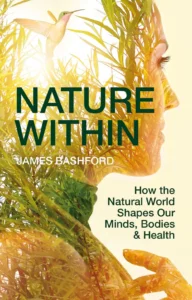
 Authored by James Bashford
Nature Within is an important and compelling read that requires time and patience to appreciate its details and messaging. The opening chapters are dense and academically written, packed with scientific terminology and concepts that may feel daunting to readers looking for a straightforward popular science read. As the book progresses, Bashford settles into a more accessible style, and the central arguments become increasingly engaging and thought-provoking.
Despite their density the early chapters provide a valuable grounding in research methodology, including explanations of hypothesis testing, evidence gathering, and the interpretation of scientific data. This foundation helps readers appreciate the detail and evidence behind the book’s wider arguments and demonstrates the author’s commitment to a robust scientific approach.
One of the book’s strengths is its ability to bridge disciplines. The author successfully weaving together medicine, neuroscience, ecology, evolution, and conservation, creating connections that many readers may not have previously considered. The discussion moves from the workings of the human body to ecosystem processes, illustrating how closely human health is entwined with the health of the natural world.
The book also explores human evolution and our transition from hunter-gatherer societies to modern industrial lifestyles. Presenting compelling arguments about how our bodies and minds evolved within natural environments and how many physical and mental health challenges may stem from our growing disconnect from nature. A particularly powerful aspect of the book is its exploration of the parallels between ecological systems, climate change and the impacts on human health. The central message, that humans are not separate from nature but an integral part of it, runs throughout the text. Bashford argues that reconnecting with nature can help us become more resilient, more self-aware, and ultimately healthier, both physically and mentally. For ecologists, much of this will resonate strongly, but the book also offers fresh perspectives drawn from medical science that add depth to familiar conservation concepts.
This is not a book to race through in a weekend. It rewards a slower, thoughtful consumption, allowing time to absorb the scientific evidence and consider the broader implications of the author’s writings. Readers willing to engage with the material chapter by chapter will find it both educational and enlightening.
Overall, Nature Within is an ambitious and intellectually stimulating book that brings together nature, medicine, and human psychology in a compelling way. While its academic tone may not appeal to every reader, those prepared to invest the time will gain a deeper understanding of the profound importance of nature to human wellbeing. It is ultimately a powerful reminder that conservation and action on climate change is not just about protecting wildlife and habitats, but about safeguarding the ecological relationships upon which our own health and future depend.