
OEP report says Government largely off-track on Environment Act targets
 Today, the Office for Environmental Protection (OEP) has published its fourth statutory assessment of the UK Government’s progress in improving England’s natural environment and delivering the legally binding targets set under the Environment Act 2021 (EA21), alongside commitments in the Environmental Improvement Plan (EIP).
The OEP’s verdict is stark: while there has been slightly more progress in the most recent reporting year (April 2024–March 2025) than the year before, government remains largely off track to meet the majority of its environmental targets and obligations, including key biodiversity targets due to be met by 2030.
Progress improving, but not at the pace or scale required
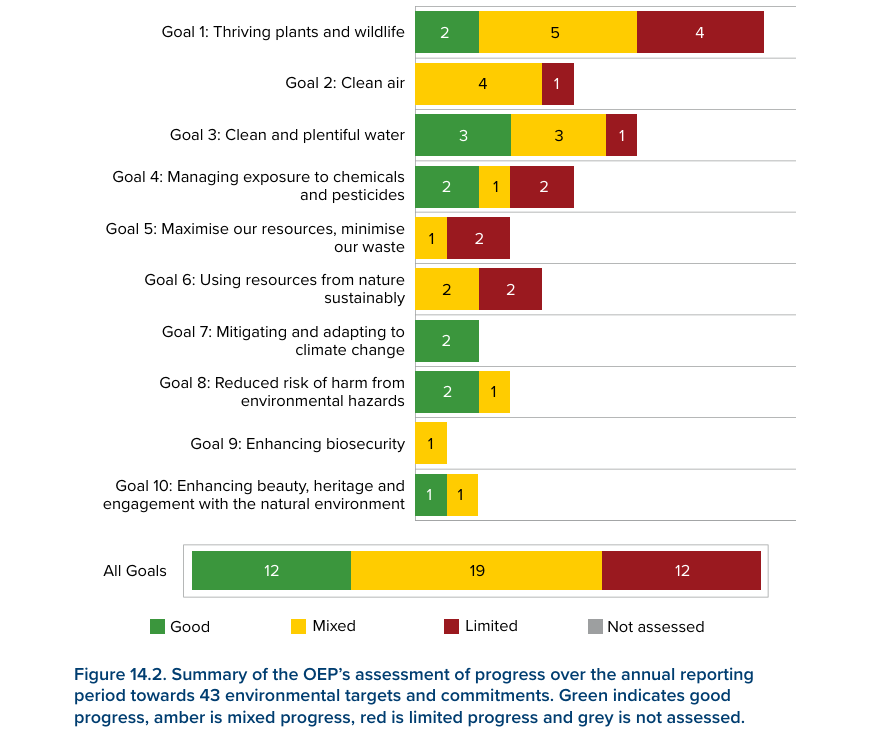
The OEP assessed progress against 43 environmental targets and commitments and found that government is:
- Largely on track to meet just five
- Partially on track for 16
- Largely off track for 21, with one target unassessed due to insufficient evidence
Of the 13 legally binding targets set under the Environment Act 2021, the OEP concludes that government is largely off track for five, partially on track for five, and largely on track for only three.
Although the report notes some improvement in progress compared with 2023/24 – particularly in relation to air quality and climate mitigation – the OEP is clear that this does not represent the step change needed to halt and reverse nature’s decline.
Nature recovery remains at risk
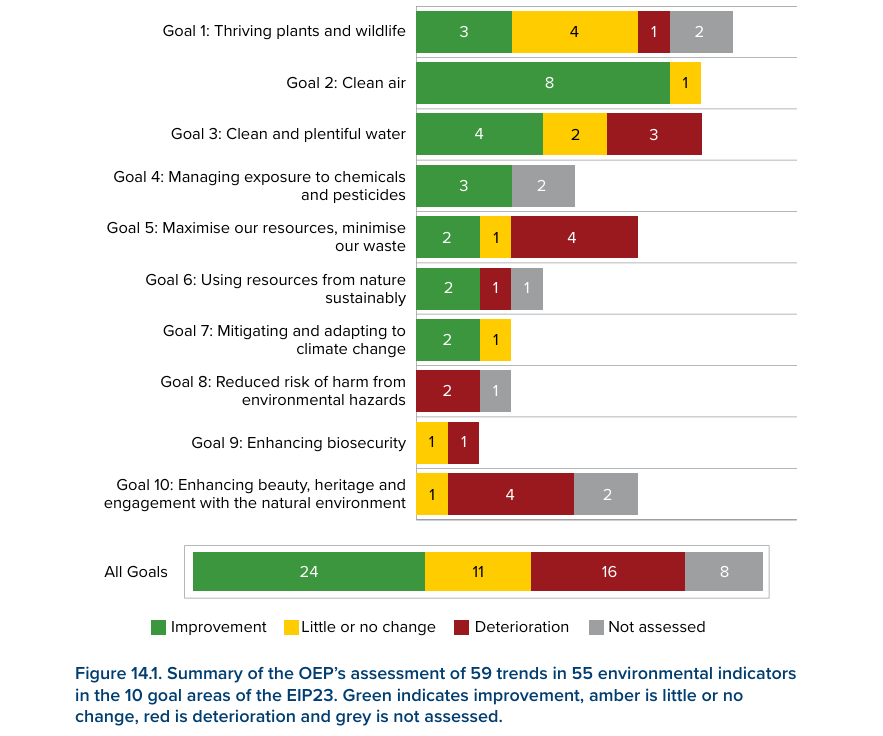
Assessing long-term environmental trends, the OEP finds that deteriorating trends dominate several goal areas, including reducing risks from environmental hazards, enhancing biosecurity, and improving people’s engagement with the natural environment.
The report warns that the window of opportunity to meet 2030 targets is closing fast, and that delays now will make future success increasingly unlikely given the time lag between policy action and ecological recovery.
Environmental Improvement Plan: more coherent, but gaps remain
The revised Environmental Improvement Plan (EIP25), published in December 2025, was not formally assessed in this reporting cycle. However, the OEP’s initial view is that the new plan is more coherent, clearer on delivery and reflects much of the advice previously provided by the watchdog.
Despite this, the OEP highlights continuing weaknesses, including:
-
Commitments that remain too broad or lacking specificity
-
Gaps in monitoring and delivery planning
-
Severely stretched resources, particularly for higher-tier agri-environment schemes
-
Continued delays to key frameworks, including the Land Use Framework
The OEP is now examining whether EIP25 can genuinely function as the “roadmap” required to deliver EA21 targets.
Nature-friendly farming and effective regulation are critical
The report reiterates the OEP’s long-standing conclusion that nature-friendly farming is the single biggest lever available to government to drive nature recovery on land and in water. Progress on sustainable soil management and uptake of higher-tier schemes, including Landscape Recovery, remains particularly slow.
The OEP also stresses that environmental law is not failing due to weak legislation, but because it is not being implemented effectively or at sufficient pace and scale. Better-designed, better-resourced regulation focused on outcomes is essential if environmental targets are to be met.
Transparency and evidence gaps hinder accountability
A recurring concern throughout the report is the lack of transparency and accessible delivery information. The OEP states that gaps in the evidence base and limited disclosure of delivery planning continue to hamper effective scrutiny and accountability.
Dame Glenys Stacey, Chair of the Office for Environmental Protection, said in the report’s foreword: “Government’s progress continues to be too slow to overcome, even to keep up with, the environmental challenges the country now faces. The window of opportunity to meet 2030 targets is closing fast.”
CIEEM perspective
The OEP’s assessment reinforces concerns long raised by CIEEM and its members across policy, planning, land management and nature conservation. Meeting legally binding targets for nature by 2030 remains possible, but only if government now acts with real urgency, coherence and sustained commitment.
Delivering the Environmental Improvement Plan at pace, resourcing nature-friendly farming properly, strengthening environmental regulation and ensuring ecological expertise is embedded across decision-making will be essential if England is to halt and reverse nature’s decline.