Integrating Ecosystem Services into Ecological Restoration
by Penny Anderson
Have you seen them? Our first Overarching Topics are just published after the successful launch of the principles and background references (2024) for Rebuilding Nature. If you have at your fingertips the 10 principles, you will know that the last, but not least, is ‘Optimise wider benefits and ecosystem services’. To assist in integrating these into your work, we have expanded this in an Overarching Topic, ‘Integrating Ecosystem Services into Ecological Restoration’.
So what are ecosystem services and why are they important? Basically they are the direct and indirect benefits provided by living and non-living components of ecosystems that support humans and their quality of life. Although this is essentially an anthropomorphic view, wildlife as critical in its own right can be incorporated too.
Some ecosystem services, especially the provisioning group, are totally integral to any habitat restoration, including nutrient cycling, primary production, soil formation and habitat provision, whilst others are more regulatory related to flood control, water quality and climate regulation. Cultural services include human health and wellbeing (mental and physical) but I maintain cultural heritage should be incorporated into this as well as part of a ‘spirit of place’.
Why think about ecosystem services? There are many reasons, all of which essentially provide a win-win situation. They:
- add selling points to different stakeholders and communities who might benefit;
- add value to the biodiversity arguments;
- can provide nature-based solutions, usually with more benefits to local users;
- can support different policies and programmes; and
- can contribute to KPIs for companies involved.
Just be careful not to let the biodiversity objectives get watered down if they are the priority.
As we cannot be all inclusive, we have focused on carbon, flood control, water quality, pollination and health and wellbeing in our Topic guidance. Climate change is too important an issue to be omitted from any ecological restoration, so thinking about carbon, its loss and future capture and storage is essential. Not all habitats are equal and it is important to make sure they are the right ones in the right place. The section is based on my review for the 2030 Climate change committee which was updated in 2023 (Carbon and Ecosystems: Restoration and Creation to Capture Carbon | CIEEM) –this will help you think about carbon and climate change, but note there is more recent research available since I completed this version.
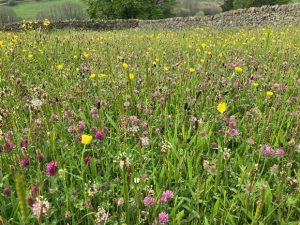
Abundant red clover in a restored hay meadow increases soil carbon sequestration ©Penny Anderson
Understanding the water cycle within ecosystems and land management helps strengthen their resilience in terms of water flows and therefore flood management. This is a key concern with climate change and an essential consideration in any ecological restoration project. We set out features to consider and approaches to incorporate. A wide variety of case studies are given ranging from slowing the flow, to flood plain restoration and a variety of other solutions.
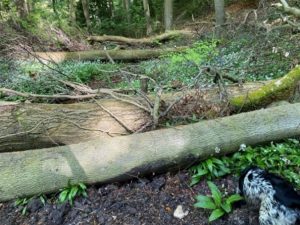
Natural Flood Management in the Slad Valley (Gloucestershire) with felled trees secured across a gully to slow overland flow and encourage infiltration ©Bruce Lascelles
Pollination underpins food production, contributes to gene flow and therefore also ecosystem restoration. It focuses on invertebrates in the UK and Ireland, the range of which is considerable and, in many cases, more important than honey bees. Wild pollinators are thought to enhance pollination services and ecosystem function giving them more resilience – important when faced with climate change and habitat loss. Advice is summarised and case studies presented.
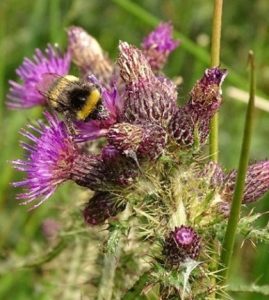
Bumblebee on marsh thistle ©Penny Anderson

Young children armed with sticks in anticipation of meeting imaginary bears in a Suffolk forest!
The Health and Wellbeing section outlines the issues and recommends an integrated approach to combine planning, design, site potential and early engagement with stakeholders to optimise benefits. The different aspects of wellbeing and of engagement are considered to optimise outcomes and a list of best practice design principles included. The synergies of these with other ecosystem services and biodiversity benefits are outlined along with further case studies.
Being web-based, the guidance can be updated and improved. Your feedback will help in achieving this – we look forward to seeing your ideas/views.