CIEEM Scotland Source to Sea Conference Blog by Andrew Tucker
From Source to Sea (02/10/2025)
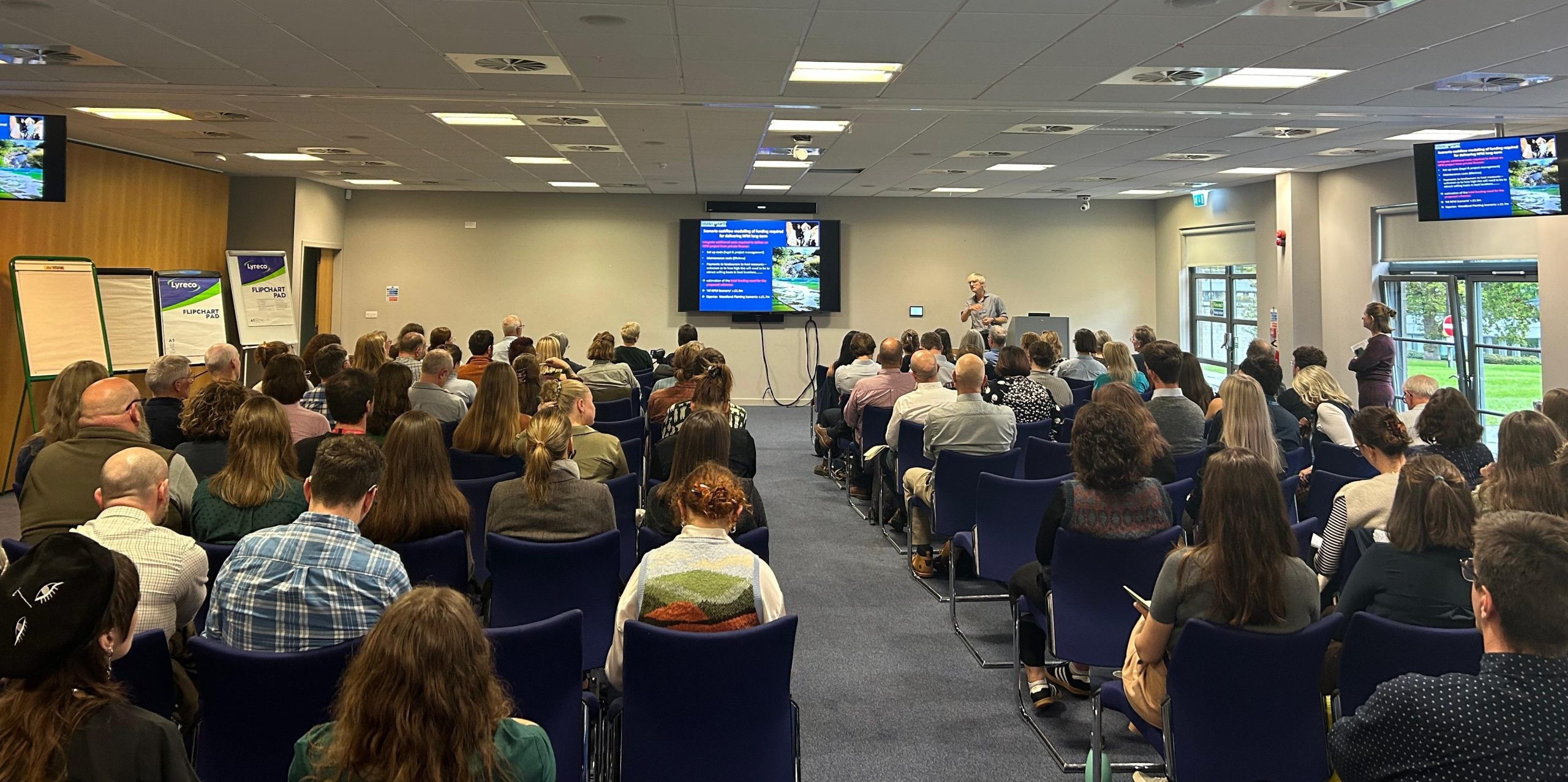
What a highlight this event was! I applied for the student draw to attend this event, as I have just started my PhD, in collaboration with ECOWILD and Heriot-Watt University. On the second day, I was off to my first-ever conference with CIEEM in Stirling, Scotland — a big thank you to Dr Annie Robinson for organising the day and running the student draw. I am grateful to have been selected for attendance. The conference featured some astonishing talks, ranging from firsthand experiences of working in environments spanning the source to sea catchments to the presentation of tools that can be used to collaborate across different industries. I was thoroughly welcomed by the Scottish counterparts and treated to some delicious vegetarian/ vegan food, starting with teas, coffees, and pastries, followed by cake, a hearty lunch, and afternoon snacks. Even snuck a pint in at the end, thank you very much! The buzz and the volume in the networking sessions were so vibrant that it is likely to have tilted the Earth’s axis in favour of the environment.
The Keynote talk opened with synergies and efficiencies from Source-to-Sea (S2S), led by Dr Chris Leakey (NatureScot). Dr Celeste Kellock was unable to attend. We hope they are OK. Chris set the scene with the International Union for the Conservation of Nature (IUCN) approach of Source to Sea, ‘to promote integrated management of land, coastal and marine resources to achieve sustainable development across the entire ecosystem’. Chris explained that even if all land-based pressures don’t lead to the sea, there was a clear need for strategy and governance to tackle the triple crisis (Climate, Nature, Pollution). The notion was that while government strategies demonstrate intent, implementation is severely limited in terms of what can be achieved. ‘Future planning should have deliberate impacts that benefit the climate, nature, and pollution, solving, minimising, or avoiding problems for the environment, the economy, and society’. Opportunities highlighted to influence these strategies were projected as the National Marine Plan 2, Land Use Strategy 4, and the next river-basin management plan (RBMP 2027-2033). It was further emphasised that incentives should align with the natural capital approach to foster ambition and drive the achievement of these insights.
Joshua Robbins, Senior River Restoration Advisor from the River Restoration Centre, led the second talk of the day, presenting a new framework for evidence-based catchment planning in the UK. Joshua expressed that there is a lack of trust in catchment plans due to previous inefficiencies over the last 40 years. It was noted that human activities and structures drive pressures, while impacts occur due to alterations in natural environmental conditions. The message was that projects should focus on impacts, not pressures, and that decision-making processes must be supported by data, which links actions to catchment impacts.
Ewan Harris, MRICS, and Ffion Robb from the Spey Catchment Initiative closed session 1 of the day with a talk on the River Calder and Allt Mor restoration projects. It was great to hear that a large tributary in the upper Spey catchment, which is vulnerable to temperature rise due to a lack of tree cover and has low fish numbers, has gained recognition for holistic restoration at a sub-catchment scale. From the installation of large woody structures to mimic deadwood in the water, to the restoration of 15ha of riparian woodland along a 3.5km stretch of the river for water temperature reduction, and investigations into how erosion scars on Allt Mor are contributing to sediment build-up and flooding in Kingussie. It goes to show what can be done in upper catchment areas to reduce impacts on lower catchment ecosystems.
Session 2 started with the theme ‘Sharper Tools for Bigger Goals: Monitoring, Mapping and the 30×30 challenge, led by Dr Lydia McGill and Dr Ruth Paterson, PIEMA, both from NatureScot. Lydia and Ruth emphasised the need for site condition monitoring, to form a database and a method for monitoring protected areas. There is a need to evolve the current approach to enhance and improve the outcomes. The Marine and Coastal Enhancement projects are key to monitoring the delivery of healthy ecosystems, and four questions from the draft framework were presented:
- What are the site priorities?
- Is positive management in place?
- Is management effective?
- What is the state of nature?
Nature30 sites, based on ‘Other Effective area-based Conservation Measures’ (OECM) and IUCN biodiversity values, have been used to develop a tool, the ‘Big Biodiversity Layer (BBL One). The primary intended application of this tool is to assess whether land parcels are suitable for development as a 30×30 site.
With the theme of sharper tools in mind, we each joined one of four workshops:
- Catchment Partnerships – Sharing Examples, Challenges and Opportunities for Source-to-Sea Restoration, led by Dr Kerry Waylen (James Hutton Institute) and Kelly Ann Dempsey, MCIEEM (River South Esk Catchment Partnership).
- Shared Ambition – How Public & Private Research Collaborations Can Accelerate Nature Conservation and Restoration in Scotland, led by Peter Baker (Edinburgh Innovations/ The University of Edinburgh) and Professor Caroline Nichol (The University of Edinburgh)
- Climate Change Scenarios: Building Narratives and Connecting Through Species, led by Dr Eleanor Gourevitch and Dr Clive Mitchell, both from NatureScot.
- Ecological Engineers and Delivering Integrated Catchment Planning: Peatlands, SuDS and Wastewater Ecosystems, led by Alexandra Combes, Scottish Water.
I had pre-selected workshop 4, and I’m glad I did. Alexandra set the scene by differentiating between the definitions of environment and ecosystems, as this was crucial for understanding nature-based solutions and the distinction between environmental engineering and ecological engineering. The workshop session discussed nature-based solutions and eco-machines, which are living machines, such as the food chain reactor at Findhorn Ecovillage. The workshop then proceeded to discuss the future of intelligent nature-based solutions (i-NBS), integrating AI, MEICA (Mechanical, Electrical, Instrumentation, Control, and Automation), and robotics. Unfortunately, we didn’t have enough time for the activity, but the insight was positive.
Session 3 took place after lunch, with a poster and networking session. Posters on display were provided by Lee Knight MCIEEM, Dr Chris Leakey, Lucy Robinson, Kirsty MacArthur, Julia McCarthy MCIEEM, Neil Harris, Dr Lyndsey Dodds, Liz Humphrey.
Following the brief poster networking session, Dr Sophie Manson and Donya Davidson from NatureScot presented the ‘Natural Capital Tool’, which is accessible for free. The tool has capabilities for natural capital asset mapping and scenario planning, to assess ecosystem services, and conduct uplift calculations with an automated reporting feature, which highlights different funding schemes available to undertake the opportunistic modelling for improved scenarios. We were treated to a demo of the tool later in the day and saw the ease of use first-hand. This tool appears to be quite valuable for cross-industry collaboration, as it simplifies remote sensing techniques that can be time-consuming to grasp.
Paul Sizeland, Fisheries Management Scotland, and Leah Reinfrank, Findhorn Nairn/Lossie Rivers Trust, delivered a talk on the evolution of the Scottish Rivers Fund, emphasising its purpose, plans, and potential going forward. These were categorised by:
- Barrier removal
- Riparian tree planting
- Wetland creation
- River-related community engagement
Paul and Leah presented the supply-side needs, which encompassed common project characteristics and fund governance considerations, followed by project examples with associated costs (estimates) and benefits of the monitoring framework. A monitoring and reporting framework is necessary to occur at various stages, including the project level, portfolio level, and tracking portfolio outcomes within corporate reporting frameworks. The demand-side should encompass sectoral approaches and business synergies, including voluntary environmental, social, and governance (ESG) efforts to align with policy and achieve efficiencies in project applications, approvals, and grant mobilisation.
Professor Chris Spray, MBE, FCIEEM, Tweed Forum/ University of Dundee, presented a link between upstream providers and downstream beneficiaries through natural flood management. Chris emphasised that restoring catchments is part of a broader interest in land use and land management, which is driven by:
- High-profile flooding instances
- Poor ecological status of rivers throughout the UK
- Climate change
- Biodiversity loss
Natural capital, ecosystem services, land use planning, woodland expansion, rewilding and community empowerment are themes underpinning progress to reverse these catchment-wide issues. Chris presented first-hand experiences from the Eddleston Water Project, which adds to the Scottish Government’s long-term study of the effectiveness of natural flood management (NFM). These studies form a ‘living laboratory using empirical and modelled evidence’ where it is possible to conduct source-pathway-receptor analyses to restore, alter or enhance, and introduce engineered natural flood protection.
Session 4 of the day focused on rivers to reefs, showing community-led restoration projects at land and sea. Kirsty Crawford from the Marine Conservation Society presented a recorded talk, “Restoring Reefs, Engaging Communities: How Citizen Science is Supporting European Flat Oyster Restoration.” Kirsty shared some of the successes with the restoration of Forth, where community feedback through the Oyster Observer citizen science program has helped monitor intertidal oysters. Hundreds of people took part in the survey, demonstrating a willing community, and the results showed a map where oysters are recolonising.
The final talk of the day was presented by Dr Alex Thompson, Seawilding, covering the integration of science and evidence-based practice into community-led coastal restoration in Loch Craignish. Alex noted that not many maps reach the sea, and that marine data in general is sparse, which adds difficulties to any organisation developing habitat mapping tools. Alex mentioned that the seagrass habitat had taken a hammering due to adverse water quality; however, natural recovery is evident where water quality has improved, with a restoration estimate of 44 m² per year across 0.9ha. In Loch Craignish, Seawilding has achieved success in transplanting from the main meadow, but has had limited success with seed and shoot transplantations, as detailed in their 2024 Seagrass Report.
To conclude the day, Roger Crofts FCIEEM spoke about the challenges surrounding the perception of success. The source-to-sea advocacy experienced on this day was delegated to everyone in the room, to spread the word and cause ripples across the source-to-sea landscape. ‘Let us involve cross-collaboration, break down communication barriers, and shift policy and policy coherence. You all know the issues surrounding greenwashing!’ Roger expressed that ‘fantastic work is being done on the ground, but there is still a lot of confusion in the air. We have seen some interesting tools today, and the other thing we have seen is that too much is happening in silos, safeguarding information, finance and processes.’