Achieving Source-to-Sea Outcomes: Incidental or Deliberate – Why does it matter?
By Dr Chris Leakey and Dr Clive Mitchell
Effort is scaling up on the restoration of ecologically degraded land and river catchments, from small land holdings to extensive rewilding projects, and from peatlands to woodlands, riparian habitats and more. Work also continues to better manage and regulate pollution and contamination of land, and ambition is growing on regenerative agriculture and broader improvements to the sustainability of land-uses.
By virtue of the way land and land-based human activities interact with water, soil and the relentless pull of gravity, these improvements to the terrestrial environment can be expected to have incidental benefits downstream, within the catchment and cumulatively all the way to coastal seas. In doing so they will improve the health and resilience of local and regional ecosystems and help repair broken earth-system processes such as the carbon, nutrient and water cycles.
So why expend effort and budget seeking governance systems and evidence to be more deliberate in the delivery of source-to-sea (S2S) benefits? What can be gained from this?
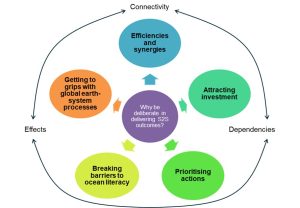
Figure 1: Five themes for promoting deliberate over incidental source-to-sea action, bounded by the inherent connectivity, effects and dependencies that link land and sea from local to global scales.
Efficiencies and synergies
Some actions or decisions on land can prevent or minimise downstream problems, avoiding the costs of solving the problem later. Other actions on land can reduce pressures on downstream environments in ways that facilitate their resilience, or even passive recovery, potentially avoiding the expense and effort of remedial action. Not only should we avoid decisions, actions or inactions in one part of society from undermining the outcomes of (or requiring additional expenditure by) another part of society, but we should actively seek shared outcomes and coordinated decision-making to reduce vulnerabilities to climate- and non-climate risks. Source-to-sea (S2S) efficiencies and synergies may also be found in other sectors, including research, innovation and business, by unlocking collaboration and coordination that taps into the inherent connectivity (effects and dependencies) between land, sea and people.
As such, deliberately taking a S2S approach would not only contribute to Public Service Reform, it will also help deliver against two of the environmental principles under the EU (Withdrawal) Act 2018: the prevention principle, and the rectification at source principle.
Attracting investment
The direct funding gap for nature protection, restoration and recovery is well known. It is typically around 1% of GDP at whatever scale is examined and the costs of inaction typically amount to 20% of GDP by the 2050s. Even while this is (apparently) well beyond the means of public finances, this framing does not include the indirect costs arising from the other 99% of GDP and is far from addressing problems at source. There is rightly a growing realisation that the public and private sector need to be aligned, with economies situated in nature and not in competition with it, and so with economic activity protecting and repairing the natural environments that society relies upon. A S2S approach to situating economies in nature can mirror the S2S flows of these effects and dependencies, and broaden the scope of remedial actions that any one business can support. A greater understanding of how a business in one part of the S2S system is dependent on or affected by the condition of the environment elsewhere in the S2S system (e.g. Figure 2), may also provide opportunity to encourage proactive investment in ecosystem restoration.
As such, developing S2S nature finance mechanisms will help deliver a further environmental principle under the EU (Withdrawal) Act 2018: the polluter pays principle.
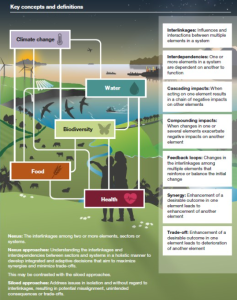
Figure 2: Water is a key element/system that links to multiple sectors, issues and other systems with which it interacts, transfers effects (positive and negative) and exhibits interdependencies. (Source: IPBES, 2024. Summary for Policymakers of the Thematic Assessment Report on the Interlinkages among Biodiversity, Water, Food and Health of the Intergovernmental Science-Policy Platform on Biodiversity and Ecosystem Services (DOI: https://doi.org/10.5281/zenodo.13850289 ).
Prioritising actions
While necessary to create a safe operating space for humanity, it is a huge challenge to meet the Scottish Biodiversity Strategy aim of being nature-positive by 2030 and to have restored and regenerated biodiversity by 2045. The efficiencies and synergies to be gained, and the private finance that S2S approaches could deliver as incremental steps towards situating economies in nature, can help meet this challenge. However, prioritisation will still be needed, identifying where and how we can gain the most benefits from our actions and investments in the first instance. Understanding effects and dependencies between land and sea are a necessary part of doing this in a fully informed way. These actions will also help to reduce vulnerabilities to an array of climate- and non-climate risks.
Breaking barriers to ocean literacy
While many people live at the coast, many live in places and in ways that are seemingly disconnected from the ocean. But the attitudes, behaviours and choices of people, communities and organisations affect the marine environment in a multitude of direct and indirect ways. Tackling the underlying causes of biodiversity loss is essential to reverse the fate of nature. These comprise: disconnect from and dominance over nature and people; concentration of power and wealth; and, prioritising short term individual and material gains. ‘Ocean literacy’ can be described as “understanding the ocean’s influence on us, and our influence on the ocean”, with S2S systems a conduit for many such influences, including for many land-locked people. Welcoming society at large into the S2S dialogue can unlock a narrative that informs and empowers people to live more lightly on the planet. Our experience so far is that the S2S narrative attracts creative engagement and can connect with the public imagination in ways that catchment management or other environmental programmes have not managed.
Getting to grips with global earth-system processes
Climate is part of the Earth system that is regulated by nature through carbon, nutrient and water cycles (e.g. Figure 2). These operate locally and give rise to global effects that underpin the fate of humanity and the natural environment. By the same token, these global effects emerge from local conditions, especially for soils, vegetation and water, that governments, businesses and communities are able to control. The beauty of the S2S approach is that we can focus on delivering local and regional outcomes while also knowingly making advances in getting to grips with the big global challenges that matter to us all. Recognising this should provide an additional driver to embrace and resource a deliberate S2S approach.
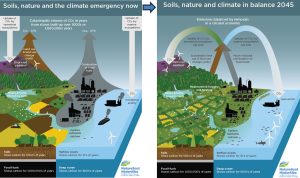
Figure 3: A source-to-sea approach can play a major role in delivering a transformative vision for the future of soils, nature and the climate, and the currently broken earth-system processes that underpin the twinned crises for nature and climate.
About the Authors
Dr Chris Leakey – Marine Sustainability Manager – NatureScot
Following a BSc and PhD in ecology, Chris has had a career mostly in public sector nature conservation, from nature reserve management to environmental assessment for development control, fisheries management, and planning policy and strategy. A temporary career move provided a grounding in social and interdisciplinary sciences, with interests in ocean literacy, behavioural change, participatory governance and more. These now percolate into his current role in NatureScot, leading work on marine planning, natural capital approaches, and source-to-sea connectivity.
Dr. Chris Leakey will be speaking at the Scotland Conference this October, sharing the stage with Dr. Celeste Kellock during the keynote session.
 Dr Clive Mitchell – Head of Terrestrial Science – NatureScot
Clive is Head of Terrestrial Science at NatureScot and leads their approach on climate-nature. In NatureScot Clive has worked as a geologist, delivering operations in Orkney, on climate, energy, sustainable development, corporate strategy and resource management. In the 2000s he was seconded to the UK Sustainable Development Commission as team leader for climate, energy, transport and buildings policy. He is an Associate Lecturer for the Open University on Earth Systems and the environment, climate, nature and food systems. He sits on the steering group of the Sustainable Scotland Network, and advisory group for WWF Scotland.
Dr Clive Mitchell will be running a workshop at the Scotland Conference alongside colleague, Dr Eleanor Gourevitch.