
National Marine Week: Citizens in the creek – How citizen scientists are helping Sea Bass thrive in Medway
Sea bass
Sea bass are one of the UK’s most important commercial fish, especially along the south coast and southern North Sea which are key spawning sites. Juvenile sea bass rely on southern estuaries such as the Greater Thames Estuary as nurseries. With rising sea temperatures, the species range is expected to shift further north, making their management in these estuaries increasingly important.
To ensure a sustainable future for this valuable species, the UK Government has introduced a Fisheries Management Plan (FMP), which includes measures tailored to sea bass.
Medway Bass Fisheries
In the Medway Estuary, a tributary of the Greater Thames, sea bass hold particular significance for the Rochester Oyster and Floating Fishery (ROFF), one of the UK’s few private fisheries. Concerned by noticeable changes in sea bass catches, ROFF took matters into their own hands.
As a private fishery, ROFF had the power to voluntarily close a northern area of the estuary to commercial fishing. Working with the Kent & Essex Inshore Fisheries and Conservation Authority (IFCA), the area was officially designated a no-take zone. While enforcement has been effective, there was no biological monitoring to assess whether the closure was benefiting sea bass populations. This is where local citizen scientists stepped in…
Citizen Scientist in Action
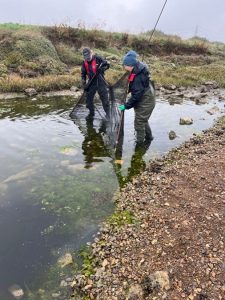 The Living River Foundation was asked to monitor the effectiveness of the no-take zone. With support from the Institute of Fisheries Management (IFM), trained volunteers began surveying four sites within the protected saltmarshes twice a year.
Volunteers are trained in fish identification and taught how to move safely through challenging saltmarsh terrain, which includes hidden creeks and limited visibility. Using specialy designed nets, they catch, measure, and record juvenile fish over a tidal cycle.
They also collect data on temperature and salinity, which helps build a more complete picture of the estuarine environment. They are provided with equipment to help them safely handle the small fish in a confident way, for example clear viewers and trays for measuring rather than the rulers used for larger fish. If the number of fish caught is too high to count in time, photos are taken so other volunteers can help analyse the data from home using image analysis software—allowing safe release of the fish back into their creeks.
The volunteers are also provided with drysuits or chest waders and walking sticks to help safe navigation.
Valuable Data
Each year since the surveys began, young sea bass (age 0+) have been recorded, along with other dominant species such as common goby and mullet. Interestingly, data from some years suggests that sea bass may be spawning twice per season (though more analysis is needed).
The findings are reviewed by the project’s Steering Group and shared with ROFF and Kent & Essex IFCA to guide management actions and improve future monitoring.
Growth of a science community
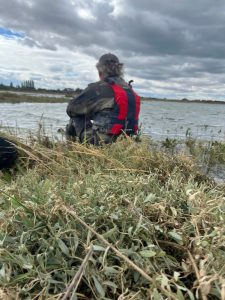 Beyond the environmental benefits, the project has brought people together. The volunteers have formed their own social group, meeting for monthly quiz nights and sharing the friendships forged on the saltmarsh. Many describe the experience as beneficial for their wellbeing, offering rare moments of quiet and calm while waiting for the tide.
The project, known as Fish of the Medway, has been recognised by Peel Ports Environmental Award 2024. Volunteers are recognised for their skills, and have gone on to support other initiatives run by ZSL and Natural England. Plans are also in place to expand the Medway monitoring to additional sites in 2025.
Scaling up: Nationally Relevant Citizen Science
Similar fish surveys, supported by the IFM, are running in other estuaries such as the Otter, Deben, and Blackwater—with more in development. Originally sparked by a Natural England initiative exploring citizen science in the marine environment, each project serves a unique local purpose.
Crucially, the methodologies used in these surveys complement those used by the Environment Agency to monitor transitional waters under the Water Framework Directive, making the citizen science data even more valuable.
A compilation of all the guidance developed in the Medway project—from health and safety to environmental best practices— is currently being made into a toolkit that other community groups can use. This means that even more grassroots marine monitoring projects could spring up across the UK in the near future.
About the Author
Tanya worked in the EA Tidal Thames fisheries team before switching to a desk in the Ports Environment team. She launched the Living River Foundation in 2018 with a citizen science project sampling microplastics on the Thames and Medway. She now runs her own business which supports the IFM with small fish surveys nationally and is a MMO appointee of the Kent and Essex IFCA Committee. She is a long-standing member of the Marine SIG in CIEEM.